Gameplay and design
The heart of Mahjong G-Taste is Japanese mahjong, with the player taking on computer-controlled opponents at an arcade cabinet. It is not a tile-matching puzzle game, even though both use mahjong tile imagery; the rules and the experience are entirely different. Players draw and discard tiles, call chi, pon and kan, and build a winning hand while competing against the computer in a one-against-many match that follows the full flow of Japanese mahjong.
As an arcade mahjong game, its match pacing and controls are built for the arcade setting. The player faces computer opponents rather than real people, so the game has to supply AI that is challenging enough to stay fun. The computer makes its decisions according to Japanese mahjong rules, while the player leans on strategy and luck to win. This format follows the mahjong games common in Japanese arcades of the time, emphasizing quick pick-up-and-play and the pleasure of single-player matches.
The game's visuals are closely tied to the manga G-Taste, with characters and art style drawn from that work. That connection is mainly a matter of presentation, though; the game does not adapt each chapter of the manga into a story mode. Players see characters and illustrations related to the manga as they play, but the core remains the mahjong match itself, and the manga background does not change the rules of mahjong.
Background and release
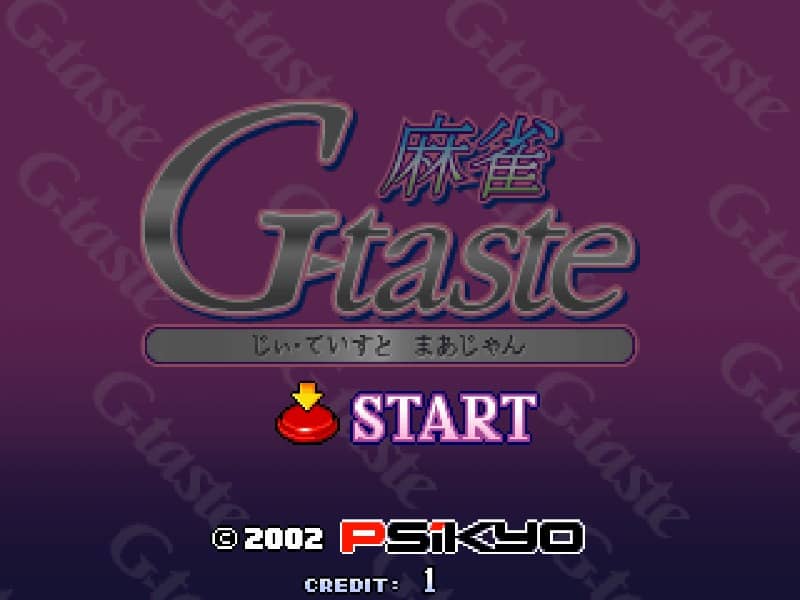
Psikyo brought Mahjong G-Taste to the Japanese arcade market in 2002. Psikyo was a company known for shoot-'em-ups, and this mahjong game stands out as an unusual entry in its arcade lineup. The game is based on Kōshi Yagami's manga G-Taste, combining Japanese mahjong with the manga's characters and artwork. Arcade records from 2002 and Japanese arcade media coverage of the time document the release and confirm its arcade identity.
The game's original platform was arcade hardware, not a home console or a native browser game. It initially ran only on arcade cabinets, with players inserting coins to play. The arcade platform shaped its design direction—matches shouldn't run too long, and the interface needs to be intuitive. The game can be accessed through a browser page today, but that is simply a current means of access and does not alter its original nature as an arcade game.
There is no reliable material to confirm further details such as the specific development team, production schedule or commercial performance. What is known is that it belongs to the later part of Psikyo's arcade output and is relatively obscure next to the company's well-known shooters. Its existence offers a concrete case for studying Psikyo's arcade releases and the Japanese arcade mahjong genre, but systematic records of its market reception and player response are lacking.
Development
Based on what can be verified, developing Mahjong G-Taste involved turning the licensed G-Taste manga property into a mahjong game. The original manga was created by Kōshi Yagami, and the game obtained a license, which allowed it to use the manga's characters and art assets. That licensing relationship shaped the game's visuals but did not turn it into a full retelling of the manga's plot. The development team's task was to work manga elements sensibly into a mahjong framework rather than simply copying the manga's story.
The game originally ran on arcade hardware, so development had to account for the display characteristics of arcade cabinets, their controls and the coin system. Arcade mahjong games generally need clear tile displays and a simple interface so players can grasp the game quickly and get into a match. There is no information on specific hardware specifications, but it is certain the game was not designed for home computers or browsers. The fact that players can run it through a browser page today is a later migration of access, not the original development goal.
Psikyo was known for shooters, and this mahjong game represents another kind of attempt by the company. Combining a licensed manga with mahjong gameplay meant handling the blending of the two properties: preserving the integrity of mahjong rules while letting fans of the manga feel the atmosphere of the original work. Because there are no specific production interviews or development documents, we cannot know the particular challenges or decisions the team faced. What can be confirmed is that the work's very existence reflects Psikyo's efforts to explore different game types in the arcade space.
Reception and legacy
Mahjong G-Taste's place in game history rests mainly on its being a title that combines a well-known manga property, arcade mahjong gameplay and a late Psikyo release. It is not a widely known major title, and there are no reliable global sales figures or aggregated media scores to consult. Any assessment therefore needs restraint: it is a product of a particular time and market, and its value lies in offering a concrete sample for studying Japanese arcade mahjong games and licensed adaptations.
From a preservation standpoint, the game can now be accessed through a browser page, which gives players who want to learn about it a way in. It is worth noting, though, that browser play is only a current technical means and does not represent the game's original design intent. For researchers or nostalgic players, being able to reach the work is meaningful in itself, because it records one facet of the 2002 Japanese arcade market and an attempt at the mahjong genre by Psikyo, a company famous for shooters.
Overall, Mahjong G-Taste had limited influence and never formed a broad player community or cultural phenomenon. Its existence is more of a small footnote in arcade history, a reminder of the diversity of Japanese arcade game genres. Players who enjoy mahjong games or are interested in manga adaptations may find some fun in it, but for a wider game audience it is probably just an unfamiliar name. Without more material, assessments should stay at the level of facts and avoid overinterpretation.