Gameplay and design
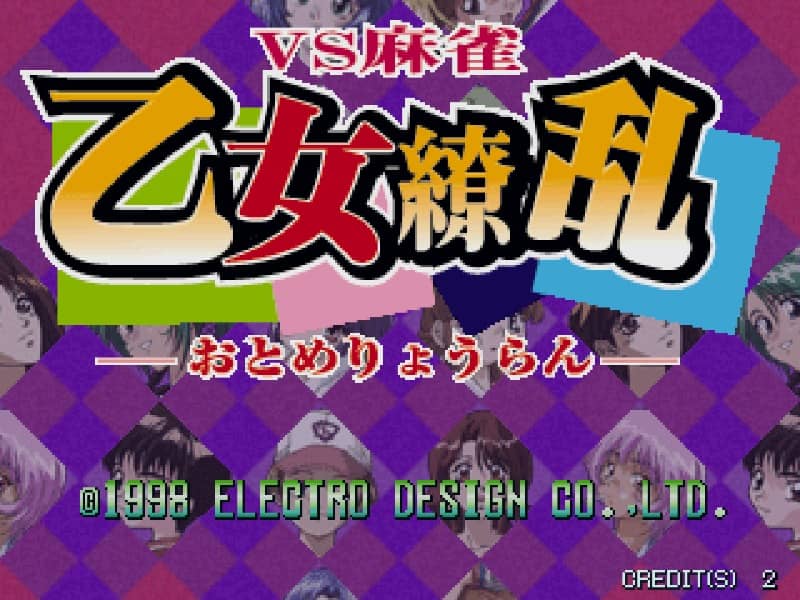
VS Mahjong Otome Ryouran is a Japanese mahjong game. Before a match begins, the player picks one of several anime-style female characters, then faces an opponent across the mahjong table. The mahjong here follows the full rules of Japanese mahjong; it is not a tile-matching puzzle game built from mahjong tile designs. The "VS" in the title highlights the way matches are presented, not a platform or version label, and the game itself never strays from mahjong into some other kind of contest.
For controls, this arcade title uses a joystick-based scheme rather than the physical mahjong button panel common to traditional mahjong games. Players select and discard tiles with the joystick and buttons, a design that stands out among arcade mahjong games and shapes how the table feels to interact with. The character elements never simplify the mahjong rules; matches still follow the basic flow of Japanese mahjong, with character selection and match atmosphere layered on top as presentation.
The character performances are a big part of this game's identity. From the selection screen onward, the anime-style women take part through visuals and animated sequences, giving matches a clearly character-driven flavor. These performances do not change the game's core as a Japanese mahjong title, though, and the decisions players make at the table still follow basic mahjong logic. Character presentation and mahjong gameplay run side by side, which gives the game its distinctive look in the arcade.
Background and release
VS Mahjong Otome Ryouran was released in Japan in July 1998 as an arcade game. Electro Design handled development and Kaneko published it. An earlier claim that credited Mitchell as developer is incorrect; Electro Design is the right attribution. The game runs on Kaneko's Super Nova System arcade hardware, one of the boards commonly seen in arcades at the time.
Judging by its title and content, this is a mahjong game aimed at the Japanese market, with anime-style character designs and female characters at the center of both character selection and match presentation. The words "otome" and "ryouran" in the name point to the character element and the lively competitive atmosphere, while "VS" emphasizes the face-to-face format. Together these naming elements explain the game's direction, but they do not change its basic genre as a Japanese mahjong game.
No reliable statistics are available for the game's sales. Its hardware and release record are fairly clearly documented, but sales figures are not within reach. Likewise, there is no verified evidence that it was ever a major competitive event or a commercial hit worldwide. When introducing this title, then, it makes more sense to focus on the known release information and gameplay features rather than speculate about its market performance.
Development
The game was developed on Kaneko's Super Nova System arcade hardware, which provided the environment it runs in. Choosing this hardware meant following the setup common in arcades of the time, and the team had to design visuals and controls around the board's capabilities. The game ultimately shipped as an arcade title in Japan, and no material suggests it was released on other platforms at the same time.
For controls, the team did not use the full physical mahjong button panel typical of traditional mahjong games, opting instead for a joystick-based scheme. That choice makes the game stand out within the arcade mahjong category, since players use a joystick and a small number of buttons to perform mahjong actions that would normally require many buttons. The available material does not explain the reasoning behind this design, but it is clear that it became a notable feature of how the game plays.
Character presentation clearly held an important place in development. The game introduces anime-style female characters from the selection screen and weaves animated sequences through matches, and together with the mahjong gameplay these elements make up the game's identity. It should be noted that there is no detailed record of the development process, team composition, or design thinking, so the behind-the-scenes story cannot be expanded further. The game's identity and hardware information are clear, but production details remain a blank.
Reception and legacy
From a preservation and documentation standpoint, the value of VS Mahjong Otome Ryouran lies in how it combined late-1990s character-driven arcade presentation with Japanese mahjong gameplay. The anime-style female characters, the selection phase, and the animated sequences give it a recognizable identity among mahjong games. That combination also makes it a concrete example for looking at how arcade mahjong was designed at the time, even though it is not recorded as an industry benchmark or a commercial hit.
In terms of series or category standing, the game did not form any documented series lineage, and there is no evidence that it had a broad influence on later titles. Its significance stays mostly with itself: an arcade mahjong game developed by Electro Design, published by Kaneko, and running on the Super Nova System, with character presentation and a sense of competition as its selling points. For enthusiasts studying arcade mahjong or 1990s Japanese arcade character games, it offers a case worth noting.
As for reception, there are no reliable ratings, awards, or player-community memories to cite, so it would be inappropriate to make claims about its influence. What can be confirmed is that its hardware and release records are fairly well preserved, while sales data is missing. This state of the record is itself a reminder that discussion of such titles should stay within the bounds of known facts and not treat speculation as conclusion. Its encyclopedic value lies precisely in honestly presenting what is known and what is not.