Gameplay and design
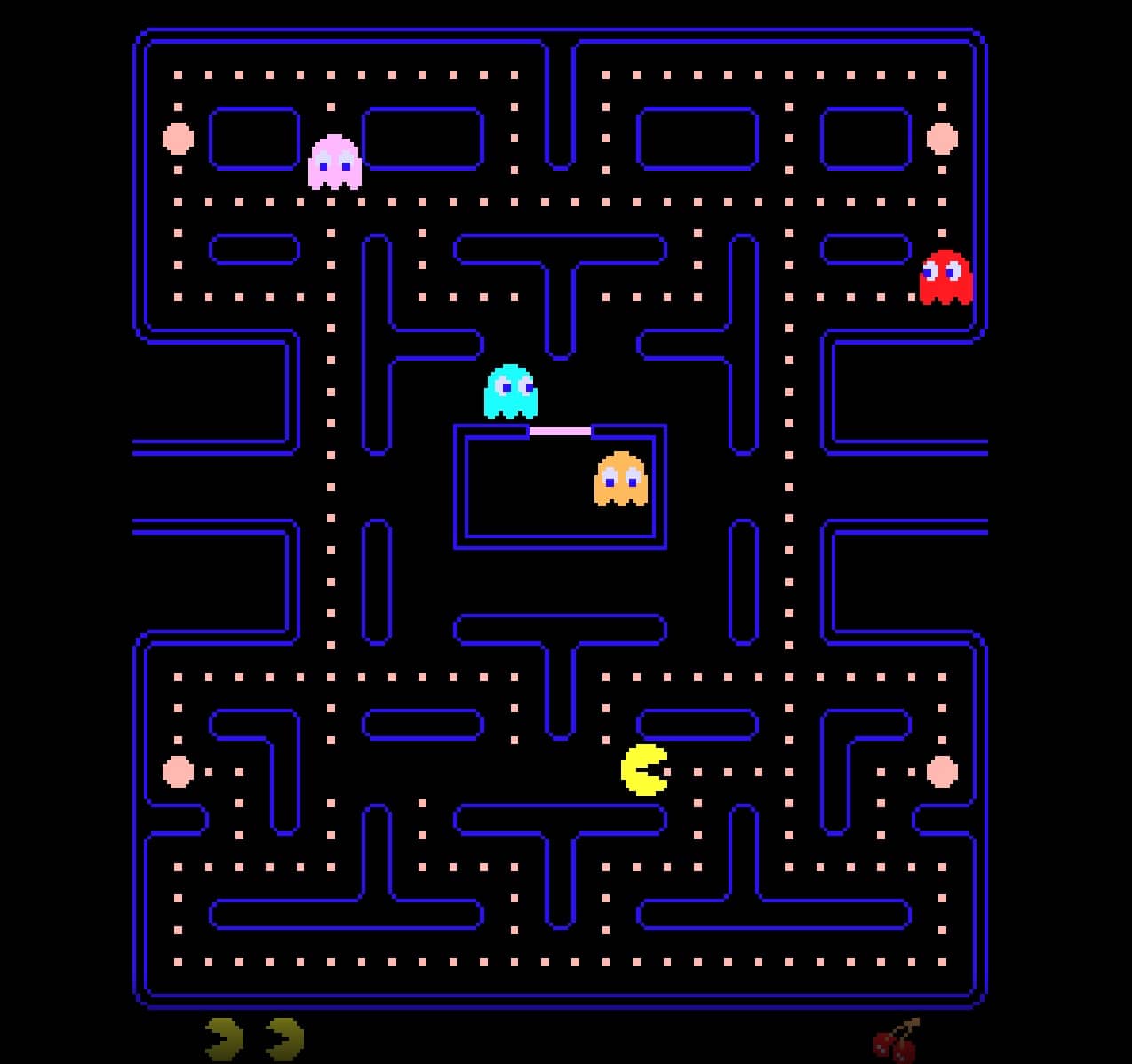
The gameplay of Pac-Man is simple yet highly engaging. Players control a yellow, pie-shaped character as it moves through a maze, eating all the small dots scattered along the paths to clear each level. Meanwhile, four colorful ghosts—Blinky, Pinky, Inky, and Clyde—chase the player through the maze. Touching a ghost ends the game, and this tension between pursuit and evasion forms the core experience.
At each corner of the maze sits a large, flashing power pellet, which is key to turning the tables. When eaten, the ghosts temporarily turn blue and flee in the opposite direction, allowing Pac-Man to eat them for bonus points. This mechanic, inspired by the concept of Popeye gaining strength after eating spinach, adds strategic depth and a satisfying reversal of fortune.
The four ghosts are not mindless pursuers; each has a distinct AI behavior pattern. Blinky directly targets Pac-Man's current position; Pinky and Inky attempt to flank by predicting the player's movement direction; Clyde alternates between chasing and retreating, making his actions unpredictable. This design ensures that every game is varied, requiring players to devise different strategies for each ghost.
As the player advances through levels, the difficulty gradually increases. The ghosts move faster, and the power pellets' effect lasts for a shorter time until it disappears entirely. By level 256, due to an integer overflow bug in the program, a 'kill screen' occurs that makes the level impossible to complete, with the maze displaying incorrectly. This classic glitch has become a famous topic in gaming history and marks the ultimate challenge of the game.
Pac-Man also stands out in its visuals and sound. The game uses Namco's RGB color display technology, giving characters bright, soft colors that contrast sharply with the dark tones of most arcade games at the time. The sound effects were composed by Toshio Kai, who, based on Iwatani's description of eating sounds, created the iconic 'wakka wakka' chomping noise, enhancing the game's immersion.
Background and release
Pac-Man began location testing in Japan on May 22, 1980, and was released nationwide in July of the same year. The North American version was published by Midway Manufacturing and hit the market in October 1980. Initially, the game received a lukewarm response in Japan, but its unique charm eventually made it the best-selling arcade game of 1980 in Japan, laying the foundation for its later success.
In North America, Pac-Man quickly sparked a craze. Within a year of its release, the game sold over 100,000 arcade cabinets and generated more than $1 billion in revenue. This achievement was nothing short of miraculous in the arcade industry at the time, making Pac-Man the best-selling arcade game in the United States in 1981, dethroning the previously dominant Space Invaders as the new market leader.
Pac-Man's success was no accident. At the time, the arcade game market was dominated by space shooters and sports games, with themes leaning masculine. Toru Iwatani keenly sensed the potential demand from female players and decided to create a non-violent, cute game. This market positioning attracted a large number of female players and families, greatly expanding the audience for arcade games.
The game's craze extended beyond arcades. Pac-Man's image quickly permeated popular culture, spawning a wide range of merchandise, animations, and songs. In 1982, the song 'Pac-Man Fever' became a hit single, and although its sales were unrelated to the game itself, it reflected the game's immense influence on the public. Pac-Man became a cultural phenomenon, not just a game.
Pac-Man's success also steered the direction of the gaming industry. It proved that non-violent, character-driven games could achieve commercial success, prompting other manufacturers to explore new genres and themes. Subsequently, maze games and character-led games gradually rose, paving the way for the diversification of video games.
Development
Pac-Man was led by Namco game designer Toru Iwatani, who headed a nine-person team. Development began in early 1979 and took one year and five months to complete. Iwatani's design goal was to create a game that would appeal to female players, as most games at the time focused on war or sports, neglecting the female audience. He wanted the game to feel light and enjoyable rather than tense and thrilling.
The Pac-Man character was partly inspired by a pizza with a slice missing. While eating pizza, Iwatani noticed the shape of the remaining slice and thought of the game character. Additionally, the design was influenced by the Japanese kanji for 'mouth' (kuchi), with its round shape and open mouth being both simple and friendly. This design later became one of the most iconic character designs in gaming history.
The game was originally named 'Puck Man,' derived from the Japanese onomatopoeia 'paku paku taberu,' meaning to gobble up. However, before the North American release, the name was changed to 'Pac-Man' to prevent players from altering the 'P' to an 'F' and creating an obscene word. Early promotional materials also used the name 'Snapper,' but 'Pac-Man' was ultimately chosen as the official name.
Pac-Man also featured numerous technical innovations. The game used Namco's RGB color display technology, giving characters bright, soft colors that stood out in an era when arcade games were mostly black-and-white or monochrome. Furthermore, the game introduced sprite animation and cutscenes, which, while not entirely new, added humor and narrative depth through the comedic interludes between Pac-Man and the ghosts.
The power pellet design was inspired by the concept of Popeye gaining strength after eating spinach. Iwatani wanted players to experience a similar 'transformation' thrill after consuming a power pellet. For the sound, composer Toshio Kai created the iconic chomping sound effect based on Iwatani's description of eating sounds. These details together formed the unique gaming experience of Pac-Man.
Reception and legacy
Pac-Man is widely regarded as one of the most influential and greatest video games of all time. It established the maze genre and introduced the concept of power-ups for the first time, providing an important reference for future game design. The game won the 'Best Commercial Arcade Game' award in 1982 and was included in the permanent collection of the Museum of Modern Art (MoMA) in New York, symbolizing the artistic value of video games.
The Pac-Man character became the official mascot of Namco and later Bandai Namco Entertainment, appearing in numerous games and media. As of 2016, all versions combined had generated over $14 billion in revenue and sold more than 43 million units, making it one of the best-selling arcade games in history. This commercial success demonstrated the immense market potential of character-driven games.
Pac-Man's influence transcended gaming to become part of popular culture. On May 21, 2010, Google changed its homepage logo to a playable Pac-Man game to commemorate its 30th anniversary, with an estimated over 1 billion people worldwide playing that version. This event not only showcased the game's enduring appeal but also highlighted its special place in digital culture.
The game also spawned numerous spin-offs and ports. The 1982 Atari 2600 port, despite being criticized for flickering graphics and poor fidelity, still sold over 7 million copies, reflecting players' enthusiasm for the game. In 1984, Namco released a Family Computer version, making it one of the early third-party games on the Famicom, further expanding the game's reach.
Pac-Man's success also inspired other game developers. It proved that non-violent, character-driven games could achieve commercial success, prompting other manufacturers to explore new genres and themes. Subsequently, maze games and character-led games gradually rose, paving the way for the diversification of video games.