Gameplay and design
The core gameplay of Taiko no Tatsujin DS - Touch de Dokodon! revolves around using the stylus on the DS touch screen to simulate striking a taiko drum. Players must tap the red "don" or blue "ka" notes on the screen in time with the music, corresponding to the drum's face and rim. Unlike the arcade version's physical drum, this game relies entirely on touch screen taps and slides, allowing players to enjoy drumming anytime, anywhere—a distinctive feature of the title.
Beyond the basic red and blue notes, the game introduces special notes such as yellow drumroll notes and balloon notes. Yellow drumroll notes require rapid tapping to build up a combo count, while balloon notes demand continuous hitting within a time limit until the balloon bursts. These special notes enrich the rhythmic variety and fully leverage the touch controls, requiring players to skillfully combine taps and slides to achieve higher scores.
The game offers four difficulty levels—Easy, Normal, Hard, and Oni—catering to players from beginners to experts. Easy is suited for newcomers, with slower note speeds and fewer notes, while Oni, the series' traditional highest difficulty, features dense and fast notes that demand quick reflexes and a strong sense of rhythm. This tiered difficulty design allows players to progressively challenge themselves and enhances replay value.
The game has no story mode; the primary gameplay involves selecting songs to perform. Players can choose from the included tracks and receive scores and ratings based on their performance. Various options are available, such as adjusting note speed or enabling auto-play, letting players customize the experience to their preferences. This straightforward arcade-style gameplay preserves the series' signature exhilaration and fits the pick-up-and-play nature of handheld gaming.
The game supports two-player play, allowing friends to cooperate or compete. While specific mode details are not elaborated in the source, the inclusion of multiplayer enhances the game's social and fun aspects. On the handheld, players can share the stylus, taking turns or playing simultaneously, to enjoy music together. This design continues the series' tradition of multiplayer enjoyment, making the game suitable for both solo and shared play.
Background and release
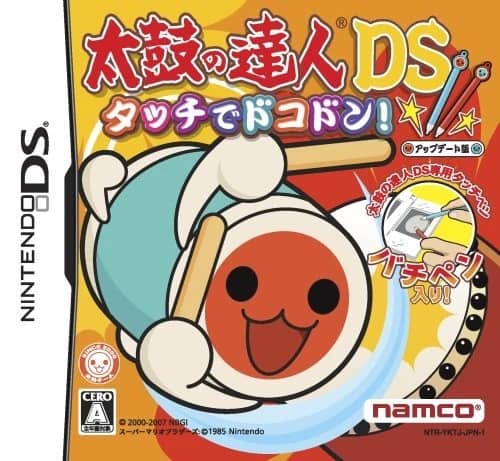
Taiko no Tatsujin DS - Touch de Dokodon! was released in Japan on July 26, 2007, at a price of 5,040 yen. As the first Taiko no Tatsujin game on the Nintendo DS, its release marked the series' entry into the handheld market. Previously, the series was primarily active in arcades, where players struck a physical drum, but this title was the first to bring that experience to a handheld, using the DS touch screen to simulate the drum surface.
The game was developed and published by Namco (now Bandai Namco Entertainment), representing a significant attempt on a handheld platform. Namco had extensive experience in music game development from the arcade scene, and the DS's touch screen technology offered new possibilities for that expertise. The development team faced the challenge of translating the physical drum's feel into precise touch screen feedback, which became a core focus of the project.
As the series' debut on the DS, this game made bold innovations in control. Unlike the arcade's physical drum, it relied entirely on touch screen taps and slides, allowing players to enjoy drumming anytime, anywhere—a defining feature. This control scheme not only changed the player experience but also set a precedent for subsequent DS and 3DS titles.
The game's song list spans various genres, including Japanese pop, anime songs, and classical music. This diversity reflects the series' tradition of attracting players of all ages through varied music. Although the complete track list is not provided in the source, it is clear that the game upheld the series' high standards in music selection, offering a rich library for players.
After release, the game received a score from the Japanese gaming magazine Famitsu, though the specific score is not mentioned in the source. Nevertheless, as the series' first DS title, its market performance and player reception laid the groundwork for future handheld versions. It demonstrated the viability of touch screen controls in music games and paved the way for the series' growth in the handheld market.
Development
The development of Taiko no Tatsujin DS - Touch de Dokodon! was driven by the series' desire to expand its appeal to handheld platforms. While the arcade's physical drum offered a realistic feel, it was limited by location and equipment, preventing players from playing anytime. The DS's touch screen technology presented new possibilities, and the team decided to leverage it to create a portable taiko game, allowing players to enjoy drumming on the go.
To realize a virtual taiko on the touch screen, the development team undertook significant technical efforts. They needed to ensure that stylus taps and slides accurately corresponded to note hits while replicating the arcade's striking feel. To this end, the game included a dedicated stylus called the "Bachi Pen," which was thicker than the DS's standard stylus, providing a grip closer to a real drumstick and enhancing comfort and precision.
This game was the first in the series to use the touch screen as the primary input method on a home console, a bold design decision for the team. They had to redesign the note judgment system to accommodate touch input characteristics. For example, sliding was introduced for yellow drumroll notes, while tapping handled red and blue notes. These refinements made touch controls not only feasible but also enjoyable.
During development, the team also focused on preserving the series' core experience. Despite the control change, the game's rhythm, note design, and difficulty curve retained the essence of the arcade versions. They aimed to allow veteran players to quickly adapt while attracting newcomers to the charm of Taiko no Tatsujin. This balance was crucial and key to the game's acceptance.
The development also reflected Namco's commitment to the handheld market. With the DS's massive success, bringing the classic Taiko no Tatsujin IP to handhelds was a strategic move to expand the product line. The game's success not only created new growth opportunities for the series but also laid the foundation for subsequent DS sequels like Taiko no Tatsujin DS: Seven Island Adventure, establishing a unique path for the series on handhelds.
Reception and legacy
As the series' first DS title, Taiko no Tatsujin DS - Touch de Dokodon! left a lasting impact on subsequent DS and 3DS versions through its touch control design. Later DS sequels, such as Taiko no Tatsujin DS: Seven Island Adventure, adopted and expanded upon this control scheme. In essence, this game established the operational standard for the series on handheld platforms.
The game's success also proved the immense potential of touch screens in music games. During the DS era, touch controls were a major selling point for many games, and this title perfectly combined the technology with musical rhythm, offering players a novel experience. This design approach was later adopted by other music games, advancing the development of handheld music games.
As a significant venture into the handheld market, this game laid the groundwork for future 3DS titles. Taiko no Tatsujin games on the 3DS continued to use touch controls and added new features, but the core touch-based drumming method originated here. Thus, this game stands as a major milestone in the series' handheld evolution.
Although specific sales figures are not provided in the source, the game's market performance and player reception were generally positive as the series' first DS entry. It successfully brought the core fun of Taiko no Tatsujin to handhelds, allowing more players to enjoy drumming anytime, anywhere. This portability became a key selling point for the series on handheld platforms.
The game's influence on later titles extends beyond controls to song selection and difficulty design. It continued the series' tradition of diverse song choices and offered multiple difficulty levels, which became standard in subsequent handheld entries. Overall, this game holds an important place in the series' history, serving as a bridge between arcade and handheld experiences.