Gameplay and design
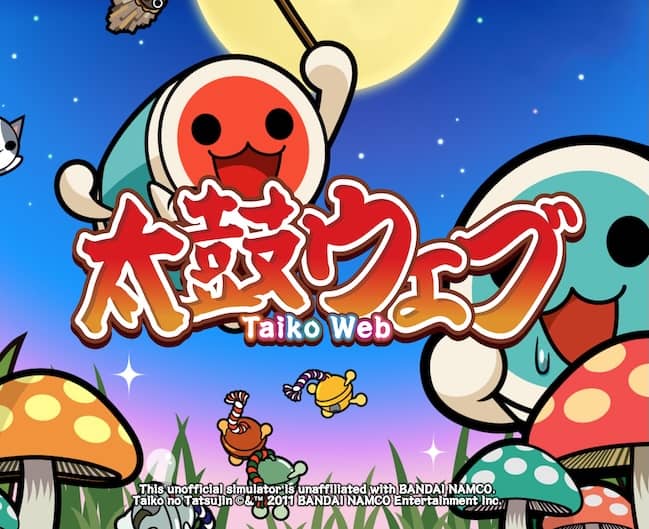
The core of Taiko Web's gameplay is bringing the "watch the notes and hit the drum" logic of the arcade Taiko no Tatsujin into the browser. In the official series, players distinguish between the drum face and the drum rim, corresponding to red and blue notes on screen; Taiko Web maps this dual-input structure directly to keyboard or touchscreen. You don't need an actual drum set—just understand what red and blue notes represent, and you can get into the rhythm within minutes. This translation may seem simple, but it captures the essence of Taiko's fun: accurately striking on the beat, letting notes and music merge.
Notes move from one side of the screen toward a judgment line, and you input when they approach that line. Consecutive hits build a combo, but a miss breaks the combo and disrupts the rhythm. This design means that chasing high scores requires not only quick eyes and hands but also a steady sense of rhythm. Difficulty selection isn't just about speeding up notes; it changes the density of the chart, the alternating hit patterns, and the distribution of long combos. On higher difficulties, the arrangement of red and blue notes becomes more complex, demanding better chart reading and hand coordination, so players of different skill levels can find a suitable challenge.
For a web rhythm game, visuals and audio may seem simple, but the real challenge is making browser timing, audio playback, and player input land on the same timeline as consistently as possible. Keyboards, touchscreens, browser audio APIs, and different devices each have their own input latency, so players may need to adjust settings or familiarize themselves with their equipment to adapt to the judgment. Taiko Web's feel largely depends on fine-tuning these details. Unlike arcade machines with dedicated hardware ensuring low latency, it aims to approximate that "hit and it sounds" instant feedback on general-purpose devices.
Custom charts are a major reason Taiko Web has long attracted players. Players aren't just consuming a fixed song list; they also create and share charts for their favorite songs. Different mirrors may have different songs, difficulties, and charts, so what you can play on one site may not be available on another. This content variation makes each deployment like a small independent world, prompting players to continually seek new chart resources. For many, opening a webpage to play a familiar song is more casual than dropping coins into an arcade machine, and closer to daily life.
Taiko Web's core appeal is simple: it breaks down a rhythm format that depends on arcade hardware into input rules that any ordinary computer can understand. You don't need to prepare a drum set first; just have a computer with internet access, and you can experience the joy of drumming. Of course, it's not a complete replacement for the official version—dedicated drum controllers, console content, and official services offer different experiences. But as a browser game, it proves that the web can host music games with high reaction demands, as long as timing, audio, and input are handled well, allowing players to immerse themselves in the rhythm.
Background and release
The public history of Taiko Web dates back to around 2015, when it was initiated by Clemaister. At that time, web technologies could already support complex interactions, but making a rhythm game in the browser was still a considerable challenge. Clemaister's project showed players the possibility of playing Taiko on the web and attracted attention from Taiko enthusiasts. This early version laid the foundation for Taiko Web's basic form: using the keyboard to simulate the drum, presenting charts on the web, and letting players experience the core arcade Taiko gameplay in the browser.
In 2018, bui forked from Clemaister's project, continued development and maintenance, and used taiko.bui.pm as the public demo entry. bui's version made several improvements and brought the project to more players. Forking is common in open-source communities, but this fork of Taiko Web proved to be a crucial step for the project's continuation. bui's maintenance kept the project alive after 2018 and attracted more developers to contribute.
However, the original Taiko Web and bui's repository later became inaccessible to the public. In early 2023, the game and its source code were taken down after a request from rights holders. This wasn't surprising, as Taiko Web used assets and gameplay from Taiko no Tatsujin, placing it in a gray area of unofficial use. The takedown saddened many players, but it also prompted the community to preserve and continue the project in other ways.
After the original project was taken down, mirrors, preserved versions, and rewrites emerged. Among them, Open Taiko explicitly calls itself a rewrite of Taiko Web, replacing the original Python backend with Node.js. This shows that Taiko Web's design has formed a lineage; later developers didn't simply copy it but continued to diverge from it. These fork projects carry on the spirit of Taiko Web and ensure players can still find web-based Taiko to play.
Looking back, Taiko Web's rise and fall are closely tied to the development of web technologies and changes in the copyright environment. It was born during a period of flourishing web games and ceased public distribution due to copyright issues. But its influence didn't disappear; it continued through forks and rewrites. For players, Taiko Web is more than just a webpage—it's an experience of "open and play a song," which many still miss and seek even after the project's takedown.
Development
The original deployment of Taiko Web involved components like Python, Flask, SQLite, WebSocket, ffmpeg, and Nginx, indicating it wasn't just a static page mini-game. Python and Flask provided backend services, SQLite stored site data, WebSocket supported real-time communication, and ffmpeg handled audio processing. These backend efforts served the rhythm experience in the browser, ensuring that the notes players see and the music they hear stay in sync.
Chart timelines, audio synchronization, and cross-device input latency are the truly difficult parts of web rhythm games. Charts need millisecond-precision timelines, and audio playback must align strictly with the charts. However, different devices and browsers vary in audio output and input response, posing challenges for developers. Taiko Web's public deployment notes suggested using Chrome to reduce inconsistencies in audio, timing, and real-time communication in older browsers. This recommendation reflects the developer's trade-offs in compatibility.
Translating the arcade's dual-input structure to a standard browser was a core design issue in Taiko Web's development. Arcade Taiko has a dedicated drum controller that provides precise hit feedback; browsers can only rely on keyboards or touchscreens. Developers needed to design a sensible mapping scheme so players could feel a drumming rhythm on a keyboard. This isn't just about key bindings; it involves judgment windows, input buffering, and visual feedback, requiring repeated tuning to achieve a playable feel.
Different forks cannot be merged into a single fixed version—this is key to understanding Taiko Web's development background. Clemaister's original project, bui's fork, and later Open Taiko, though all called Taiko Web or self-described rewrites, have completely different code structures, features, and song libraries. bui forked from Clemaister's project in 2018, meaning he continued development on the existing base rather than starting from scratch. Open Taiko, on the other hand, was a complete rewrite, changing the backend technology stack. These differences give each version its own unique development story.
Developing a project like Taiko Web requires a deep understanding of rhythm games and proficiency in web frontend and backend technologies. Clemaister and bui were both players themselves; they developed this project out of love for Taiko, not for commercial purposes. Such unofficial player projects often prioritize purity of gameplay and community feedback. Taiko Web's development also reflects the collaborative nature of open-source communities: some handle code, some create charts, some deploy mirrors, all working together to keep the project running.
Reception and legacy
Taiko Web's biggest impact is providing a low-barrier entry point to a rhythm game that typically requires dedicated hardware. Before it, playing Taiko no Tatsujin meant going to an arcade or buying a console version with a dedicated drum controller. Taiko Web broke this limitation, allowing anyone with a browser to experience the joy of Taiko. This low barrier attracted many new players and gave veterans an alternative when arcades weren't accessible. It proved that browser games aren't just for short, casual play; they can also host music games with high reaction demands.
The community life driven by player-created charts and song sharing is another important legacy of Taiko Web. Custom charts let players move beyond passively consuming the official song list, allowing them to create and share content for their favorite songs. This UGC culture greatly extended the project's lifespan and fostered a rich content ecosystem across different mirrors. Even after the original project was taken down, player-made charts continue to circulate in the community, becoming part of Taiko Web's culture.
The fact that it was preserved and rewritten after being taken down reflects that what players truly wanted to keep wasn't just a webpage, but the experience of "open and play a song." Mirrors and preserved versions keep the original project alive, while rewrites like Open Taiko carry this experience forward on new technical foundations. This continuity shows that Taiko Web has transcended being just a game, becoming a cultural phenomenon maintained by players. It reminds us that even if a project stops development, as long as players need it, it will exist in other forms.
Of course, it must be clear that Taiko Web has always been an unofficial fan work. It uses assets and gameplay from Taiko no Tatsujin but has not been authorized by Bandai Namco or the music rights holders. Therefore, its existence has always been in a copyright gray area, which is one reason the original project was taken down. Players enjoying Taiko Web should understand its unofficial status and respect the rights of the copyright holders.
In summary, Taiko Web's significance lies in breaking down a rhythm format dependent on arcade hardware into input rules that any ordinary computer can understand, and in enabling players to continue creating around charts. It introduced more people to the joy of Taiko and showcased the potential of web games. Although it has ceased public distribution, its influence continues in fork projects and player communities. For rhythm game enthusiasts, Taiko Web is a memorable piece of web game history.