
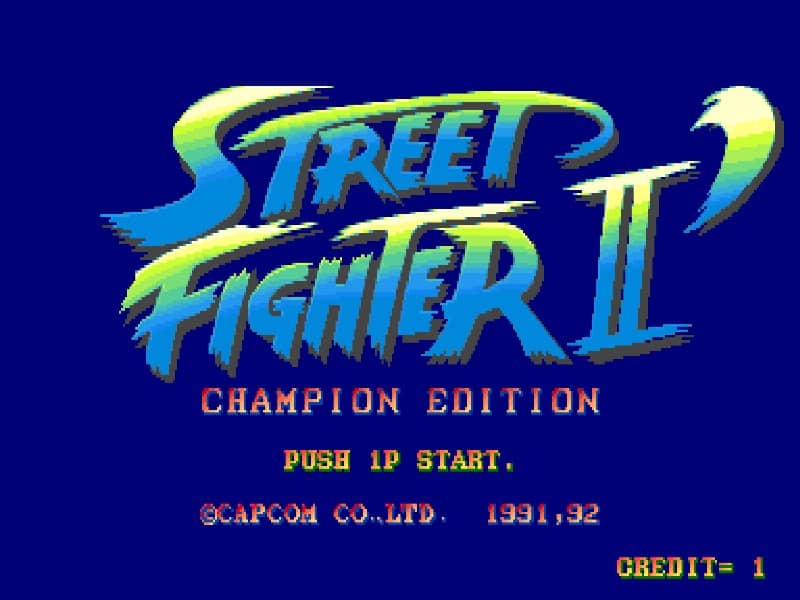
Gameplay and design
The most striking change in "Street Fighter II - Champion Edition" is that the four bosses, previously only controllable by the computer, are now selectable by players: the boxer, the claw-wielding Spanish fighter, Sagat, and the final boss. Their English names are swapped between the Japanese and overseas versions, so it's easy to mix them up if you only look at the names. Champion Edition rebalanced these characters for player use, preserving their distinctive moves while fitting them into the twelve-character versus framework.
Mirror matches are another key feature introduced in Champion Edition, marking the first time in the series that players could choose the same character to fight each other. To distinguish the two fighters, the system gives one player the standard color scheme and the other an alternate, with a blue name tag displayed below the health bar. This design solves the visual confusion and set a common precedent for handling mirror matches in later fighting games. Players can select the standard or alternate color by pressing different buttons during character selection, making it simple and intuitive.
Beyond the new content, the original eight characters also received a round of adjustments to their moves and stats. The most representative change occurs with Ryu and Ken: in "The World Warrior," they were nearly palette swaps, but Champion Edition begins to differentiate their move properties. The differences are not as pronounced as in later versions, but they send a clear signal to players that similar appearances and basic commands do not mean identical practical choices. This gradual approach to distinguishing character identities became an important direction for the series' ongoing adjustments.
The single-player mode also changed. Players now face all 12 characters, including a mirror match against their own chosen character. This increases the challenge, requiring players to be familiar with all characters' traits, including the formidable former bosses. This design enriches the single-player content and tests players' comprehensive understanding of the game system.
Champion Edition also features improvements in graphics and sound. The color schemes of each character's stage background have been adjusted for a more vibrant visual style; character portraits have been redrawn with more detail; and some characters' ending scenes have been modified. Additionally, new background music accompanies the staff roll, providing an extra reward for players who complete the game. These refinements make Champion Edition a more polished experience overall compared to the original.
Background and release
"Street Fighter II - Champion Edition" was released by Capcom in 1992, with the Japanese version titled "Street Fighter II Dash." It is the first update to "Street Fighter II: The World Warrior" and belongs to the Street Fighter series. At the time, "The World Warrior" had already achieved massive success in the arcade market, and the release of Champion Edition further solidified the series' leading position in the fighting game genre.
Champion Edition performed impressively in the arcade market. In Japan, approximately 140,000 units of "Street Fighter II Dash" arcade hardware were sold at 160,000 yen each, generating hardware sales of 22.4 billion yen. In the United States, Champion Edition sold between 20,000 and 25,000 arcade units, comparable to "The World Warrior" sales. These figures indicate that Champion Edition continued the commercial success of its predecessor, becoming a popular machine in arcades.
In Japan in 1992, "Game Machine" magazine listed "Street Fighter II Dash" as the most successful tabletop arcade game in May. That same year, Champion Edition was the second highest-grossing arcade game in Japan, trailing only "The World Warrior." In the U.S., Champion Edition had high orders upon its debut in March 1992 and topped RePlay's May upright arcade revenue chart. These achievements demonstrate its popularity among players.
Champion Edition's popularity lasted for a considerable time. From June to September 1992, it held the top spot on the Play Meter arcade chart. According to RePlay and AMOA, Champion Edition was the highest-grossing dedicated arcade game in the U.S. in 1992. At the ACME (American Coin Machine Exposition) in March 1993, Champion Edition was also named "Best Game of the Show" by RePlay and Play Meter magazines, reflecting its lasting influence.
However, Champion Edition's arcade lifecycle was relatively short. A few months after its release, Capcom launched "Street Fighter II Turbo: Hyper Fighting" as another update to the series. Hyper Fighting made further adjustments to speed and moves, quickly replacing Champion Edition in arcades. Nevertheless, Champion Edition, as the first update, left an important mark in the series' history.
Development
The development concept for Champion Edition was clear: to extend the game's lifespan by adding playable characters and introducing new features on top of "The World Warrior." The four bosses were originally CPU-exclusive, and their move sets were already well-designed, but to accommodate player control, the development team adjusted their strength. This balance tuning was a key focus, aiming to preserve the bosses' uniqueness while avoiding making them too powerful and disrupting game fairness.
The introduction of mirror matches was a crucial decision in Champion Edition's development. This feature was uncommon in fighting games at the time and required solving the problem of distinguishing two identical characters. Ultimately, the team adopted color differentiation and name tags, which was both simple and effective. This design was later borrowed by many fighting games and became one of the standard approaches to mirror matches.
In terms of graphics, the development team meticulously polished the game. The color schemes of each character's stage background were readjusted to enhance visual depth; character portraits were redrawn with finer lines and colors; and some characters' ending scenes were modified to align with the new characters and story settings. These changes, though not major, improved the overall visual appeal.
For music, Champion Edition added new background music for the staff roll sequence, while the rest of the main tracks and sound effects continued from "The World Warrior." It was not a from-scratch sequel but a reworking of already mature assets with limited changes; the new portraits, stage colors, and ending scenes, combined with rule changes, allow players familiar with the original to recognize it at a glance while quickly noticing this is not the same fighting environment.
After development, Champion Edition underwent multiple ports and compilations. It was included in "Street Fighter Collection 2" (PS/SS), "Capcom Classics Collection Vol. 1" (PS2/Xbox), and others. In 2011, Champion Edition was bundled with "Street Fighter II" and "Street Fighter II Turbo" in the iOS version of "Street Fighter II Collection." The "Street Fighter 30th Anniversary Collection" also includes the overseas version of Champion Edition with online play support. These ports have allowed more players to experience this classic.
Reception and legacy
Champion Edition received widespread acclaim upon release. At the sixth annual awards by "Gamest" magazine in February 1993, "Street Fighter II Dash" was named Best Game of 1992 and also won Best Action Game. This honor not only affirmed the game's quality but also reflected its influence among players and the industry.
Champion Edition was the first in the "Street Fighter II" series to officially support mirror matches. Today, mirror matches are a standard feature in fighting games, but at the time, they directly changed the freedom of character selection. Two skilled players no longer had to avoid choosing the same character, allowing them to more purely compare spacing, timing, and habits. The use of alternate colors and name tags was simple and effective, becoming a common approach for handling mirror matches in subsequent games.
The balance adjustments in Champion Edition, particularly the differentiation of Ryu and Ken, had significant implications for the series' future. This differentiation made characters more distinct and provided ideas for character design in later fighting games. The character differences players experienced in Champion Edition became a hallmark of the "Street Fighter" series and continue to this day.
Champion Edition's commercial performance also proved that a popular arcade game doesn't need to wait for a full sequel; by opening up characters, revising rules, and adjusting balance, it can create a new fighting environment. Capcom continued to release versions like "Hyper Fighting" and "Super Street Fighter II," each with different speeds, characters, and move states. For players, this wasn't simply selling the old game again; it introduced the question of "which version are you playing," which genuinely affects communication and competition.
Today, Champion Edition is still regarded by many players as one of the most classic versions in the "Street Fighter II" series. It has been included in multiple compilations, including the "Street Fighter 30th Anniversary Collection," allowing a new generation of players to experience it. Arcade1Up also released a home arcade cabinet featuring Champion Edition, Super Street Fighter II, and Super Street Fighter II Turbo, further extending its legacy. Champion Edition's place in fighting game history lies not only in its innovations but also in the pure fun it brought to players.





