
Gameplay and design
The most immediate innovation in Street Fighter II was expanding the typical arcade fighting game controls from a joystick and two or three buttons to six attack buttons. Light, medium, and heavy punches and kicks each offered different speeds and power, allowing players to combine them into a wide variety of attacks. This design gave characters options at both close and long range, and set the standard for the six-button layout that later fighting games would adopt.
Beyond basic attacks, the game introduced special moves executed through specific joystick directions and button combinations, such as the Hadouken and Shoryuken. These moves required practice to pull off reliably, but once mastered, they enabled flashy and effective offense in real matches. This design made the act of inputting commands a pleasure in itself, and became one of the core appeals of the fighting game genre.
The game offered eight selectable characters: Ryu, Ken, Chun-Li, Guile, Blanka, Dhalsim, Zangief, and E. Honda. Each had a completely different physique, moveset, and fighting style, from Zangief's close-range grappling to Dhalsim's long-range yoga fire. Players could always find a character that suited their playstyle. Such character diversity was rare in arcade games at the time.
In the single-player mode, players fought through the other seven characters in sequence, then faced four CPU-only opponents: Balrog, Vega, Sagat, and the final boss, M. Bison. These bosses could not be selected directly and had to be defeated in challenge. Their moves were more vicious and their AI smarter, providing a significant challenge and making the sense of accomplishment after clearing the game even stronger.
The most appealing aspect of the game, however, was the two-player versus mode. A second player could drop in at any time, and the winner stayed on the machine. This design often drew crowds in arcades, with onlookers cheering for impressive exchanges and lamenting unexpected upsets. Every three matches, there was a bonus stage where players could smash a car, barrels, or oil drums for extra points, offering a brief respite from the intense battles.
Background and release
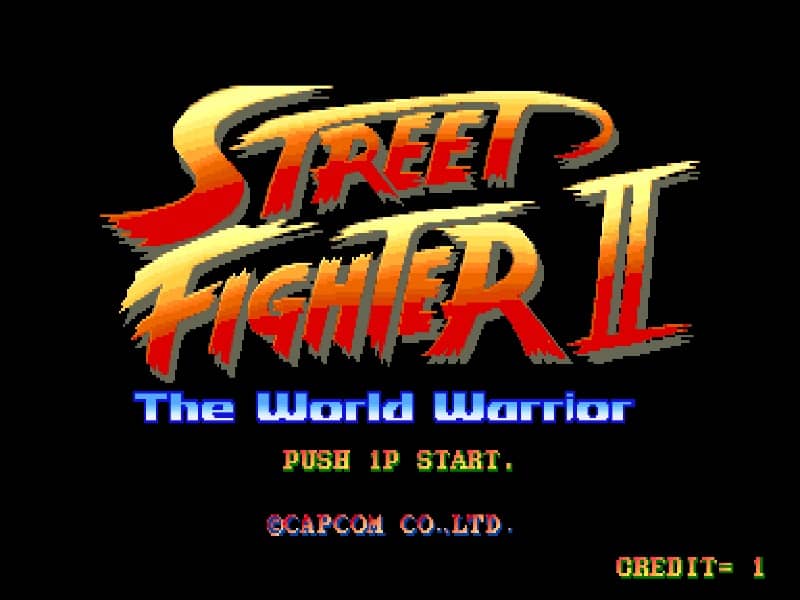
Street Fighter II made its debut at the ATEI show in London in January 1991, followed by a two-week field test in North America. On February 1 of that year, Capcom officially unveiled the game at a distributor meeting in Fort Lauderdale, Florida. At the time, no one expected that this seemingly ordinary new arcade title would change the course of the entire gaming industry over the next few years.
When the game first hit Japan, its performance was not particularly outstanding. Many players were accustomed to playing single-player modes alone and were not yet familiar with the fun of two-player versus. Later, the game magazine Gamest introduced the versus feature, and players gradually discovered that competing against a real person was far more interesting than fighting the computer. As word of mouth spread, the game's popularity soared, eventually reaching the top of Japan's Game Machine magazine arcade charts in 1991.
In the United States, the game was even more explosive. In test markets, a single machine could bring in $1,300 to $1,400 per week, far exceeding typical arcade games. From May 1991 to August 1992, it held the number one spot on the RePlay arcade software chart for 16 consecutive months. By 1994, it was estimated that around 25 million Americans had played the game, a staggering number for the time.
The success of Street Fighter II directly revitalized the arcade industry. Before its release, arcades were struggling under the pressure of home consoles, and business was sluggish. This game brought back long lines at arcades and attracted many who had not frequented them before. Its popularity also spawned a wave of imitators, such as Mortal Kombat, and it could be said to have single-handedly revived the entire industry.
Of course, Capcom did not rest on its laurels. In 1992, they released an updated version, Champion Edition, which allowed players to select the four bosses and included more balance adjustments. But that was later. For the original Street Fighter II, it had already fulfilled its historical mission: making players around the world remember the name "fighting game."
Development
The development team for Street Fighter II was led by Yoshiki Okamoto as designer, with Akira Yasuda handling character design; both had previously worked on Final Fight. The producer was Noritaka Funamizu. The project took about two years and involved roughly 35 to 40 people. For arcade game development at the time, this was a sizable team, reflecting Capcom's commitment to the title.
The game ran on Capcom's own CP System arcade board, which was the 14th game to use it. The CP System's graphics and sound capabilities were quite impressive for the era, delivering colorful, fluid visuals that provided the hardware foundation for the game's impact. The development team made full use of these capabilities, giving each character's moves a strong sense of force.
Most of the game's music was composed by Yoko Shimomura, marking her only contribution to the Street Fighter series. Shimomura later became famous for soundtracks like Kingdom Hearts, but her work on Street Fighter II is equally notable. The rhythmic background music perfectly matched the tense atmosphere of battles and became classic melodies in many players' memories.
The most interesting anecdote during development was the accidental discovery of the combo system. While debugging, programmers found that characters could hit opponents multiple times in succession under certain conditions, forming a multi-hit attack. This bug might have been fixed, but the team felt it made combat more satisfying and deliberately kept it. This unintentional decision later became one of the most core mechanics in fighting games.
Before the official release, the game underwent field testing in North America. During these tests, players showed great enthusiasm for the two-player versus mode, leading the team to realize that versus play was the game's true selling point. They then adjusted their marketing strategy to emphasize this feature. This decision proved to be correct and laid the groundwork for the game's later success.
Reception and legacy
Street Fighter II is widely regarded as the most influential fighting game of all time. It defined the basic framework of the genre: six-button controls, command inputs, character selection, and two-player versus. These elements became standard for fighting games that followed. Without it, there would be no King of Fighters, Tekken, or many other classic titles.
The game's impact on arcade culture was particularly profound. Before it, arcade players mostly chased high scores, competing in single-player games. Street Fighter II shifted the focus to head-to-head competition between players, turning arcades into arenas. This change not only altered arcade culture but also laid the groundwork for future esports events.
Commercially, the game topped arcade charts in both Japan and the United States, holding the number one spot on the RePlay software chart for 16 consecutive months. During testing, a single machine could earn $1,300 to $1,400 per week. More telling than numbers were the changes in arcades: operators were willing to add more cabinets, and players gradually moved from taking turns against the computer to queuing up for matches against real opponents. It brought substantial returns to Capcom and helped the arcade market, which was under pressure from home consoles, regain its popularity.
The game also spawned a host of imitators and derivative versions. Besides Capcom's own updates like Champion Edition, other companies followed suit with various fighting games. While the quality of these imitators varied, they objectively contributed to the flourishing of the fighting game genre. Even today, we can see its influence in new entries of the Street Fighter series.
For many players, the significance of Street Fighter II extends beyond rules and sales. Queuing up to insert coins, memorizing opponents' habits, and crowding around a cabinet to watch a match—these concrete experiences formed a generation's arcade memories. It transformed fighting games from an unformed genre into a competitive game that players worldwide could quickly understand and willingly master over time. Later works added more systems and characters, but they still build upon the basic language established in 1991.





